Answer Engines Do Not Wait: Why Server Speed Decides Whether AI Quotes You
Answer Engine Optimisation is the newer cousin of SEO. Instead of ranking in a list of blue links, you are trying to be the source an AI assistant quotes when somebody asks it a question.
Almost all the advice about it is about words: structure your headings, answer questions directly, add an llms.txt file. All of that is true. All of it is also useless if the machine gives up before your page arrives.
Somebody asks a question. The assistant decides it needs current information, picks a handful of URLs, and fetches them — while a real person sits watching a cursor blink.
That is the whole budget. These fetchers are not patient the way Googlebot is patient. Googlebot can come back tomorrow; an answer engine has a few seconds and a waiting human. If your server is still thinking, it moves on to a source that replied. You are not penalised, exactly. You are simply not in the answer.
Two more things worth knowing about how they read:
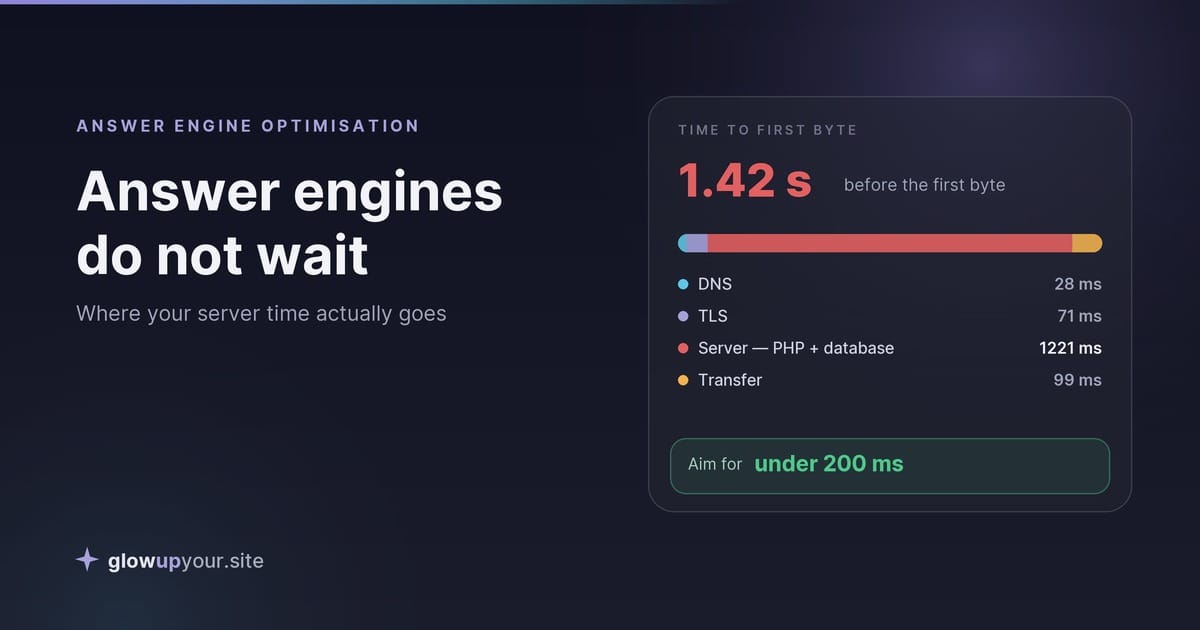
When we measure a slow WordPress site, the delay is almost never the download. It is the gap before the download starts — the server working out what to send. That is Time to First Byte, and it is a CPU number, not a connection-speed number.
Every uncached WordPress request means PHP starting up, plugins loading, a theme initialising, and dozens of database queries running before a single character is sent. On a healthy setup that takes a moment. On a typical small business site it does not, and the usual reasons are boringly consistent:
Aim for: under 200 ms to first byte. Between 200 and 600 ms is survivable. Past a second, you are gambling with every AI fetch and every impatient human.
Find out how long your server takes to answer
Our free speed test runs Google’s official PageSpeed check on your site for mobile and desktop, including server response time — the number that decides whether an answer engine waits for you.
In rough order of how much they return for the effort:
Once your server answers quickly, the content advice starts paying for itself. Put one clear question in each heading and answer it in the first sentence underneath. Write the specifics — prices, timescales, areas covered — as plain text rather than hiding them in an image or a PDF. Keep an llms.txt so the crawlers can find your important pages without guessing.
That work is worth doing. It is just second in the queue, and most guides have it first.
AEO is sold as a content problem. For most small business websites it is an infrastructure problem wearing a content problem’s clothes.
You can write the clearest, most quotable page on the internet about exactly what somebody just asked. If your server takes a second and a half to admit the page exists, the assistant will quote a competitor who answered faster and said it worse.